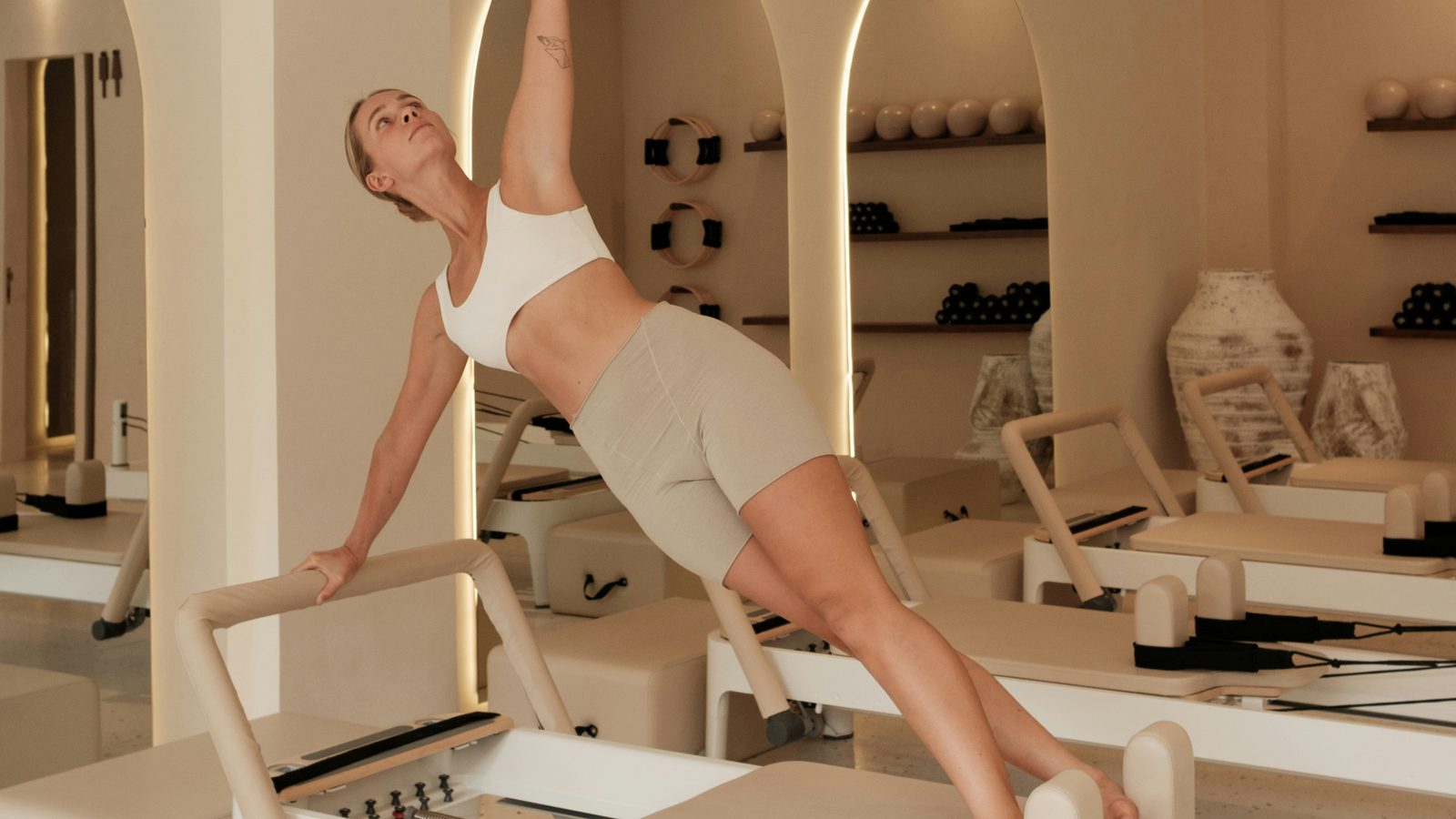
A reformer is a carriage on rails, pulled back toward the footbar by springs, with straps at the far end for the hands and feet. A board keeps the carriage idea, swaps the springs for an elastic cord and two bands, drops the straps and the footbar, and folds in half. That is the whole relationship. Everything a board can and cannot do follows from it.
What carries over
The sliding carriage is the thing people miss when they leave a studio, and a board has one, or at least a pair of glide pads that behave like one. Lunges with the back foot sliding, kneeling pikes, mountain climbers, bridges with the feet gliding out and back: the board does these the way the carriage does, with your body weight as the load and the elastic cord as the return.
The bands cover the arm work. Clipped to the end anchors, they give rows, chest presses and overhead reaches from kneeling or seated positions. On the boards that state a tension it is 15 to 25 lb a band; on the rest it is whatever the seller bought.
What does not
Spring resistance. A reformer’s springs are the load for footwork, leg presses and the long series of supine work, and they go from a light stretch to more than your body weight. A board has no springs. Its load is you, plus bands that top out where a reformer starts. If what you want from pilates is the leg press and the heavy footwork, a board will feel like a warm-up within a month.
Straps. The reformer’s hand and foot straps are how the supine leg circles, frog, short spine and the arm series happen. No board has them, and no board can, because there is nothing at the far end to pull against. Bala’s strap band, anchored in a door, is the nearest thing on a budget and it is a different piece of equipment.
The footbar and the length. A reformer is seven to eight feet long so that a full leg extension fits. A board is 42 inches. Stride length on a board lunge is what the groove allows.
What a reformer costs you
Floor. A folding reformer needs 7 to 8 feet set up and still takes a 42 to 47 inch footprint folded. Weight: 56 to 71 lb for the AeroPilates folding models, which is a two-person carry up stairs. Money: a folding reformer with real springs starts around the price of eight boards, and the studio-grade machines start at ten times that. A board is ten pounds, slides under a bed, and most of them cost less than a month of classes.
So which
If the reformer work you want is the sliding lunges, pikes and bridges, and some band rows, a board gives you that for the price of a few classes and stores anywhere. Buy one, buy a mat to put under it, and expect to replace the bands.
If you want the leg press, the straps, or resistance that grows with you, a board will disappoint you quickly, and the money is better saved toward a folding reformer with springs. The folding reformers page compares the ones that fold and the ones that pretend to.
If you are not sure, a pair of gliding discs and a bar kit cost less than any board, do most of what it does, and tell you in a month which side of the line you are on.